LCM of Fractions Calculator
Enter two or more fractions to find their least common multiple, with the formula and steps shown.
The formula
For whole numbers, the LCM is the smallest number that every number divides into — and if your numbers are whole to begin with, the regular LCM calculator is the tool for the job. Fractions work the same way, with one extra idea: a number counts as a multiple of a fraction when dividing by that fraction gives a whole number.
LCM of fractions = LCM of the numerators ÷ GCD of the denominators
Why the split? The top half has to be a multiple of every numerator, and the smallest such top is the LCM of the numerators. The bottom half has to divide every denominator, and the largest such bottom is the GCD of the denominators. Put them together and simplify if you can.
Worked examples
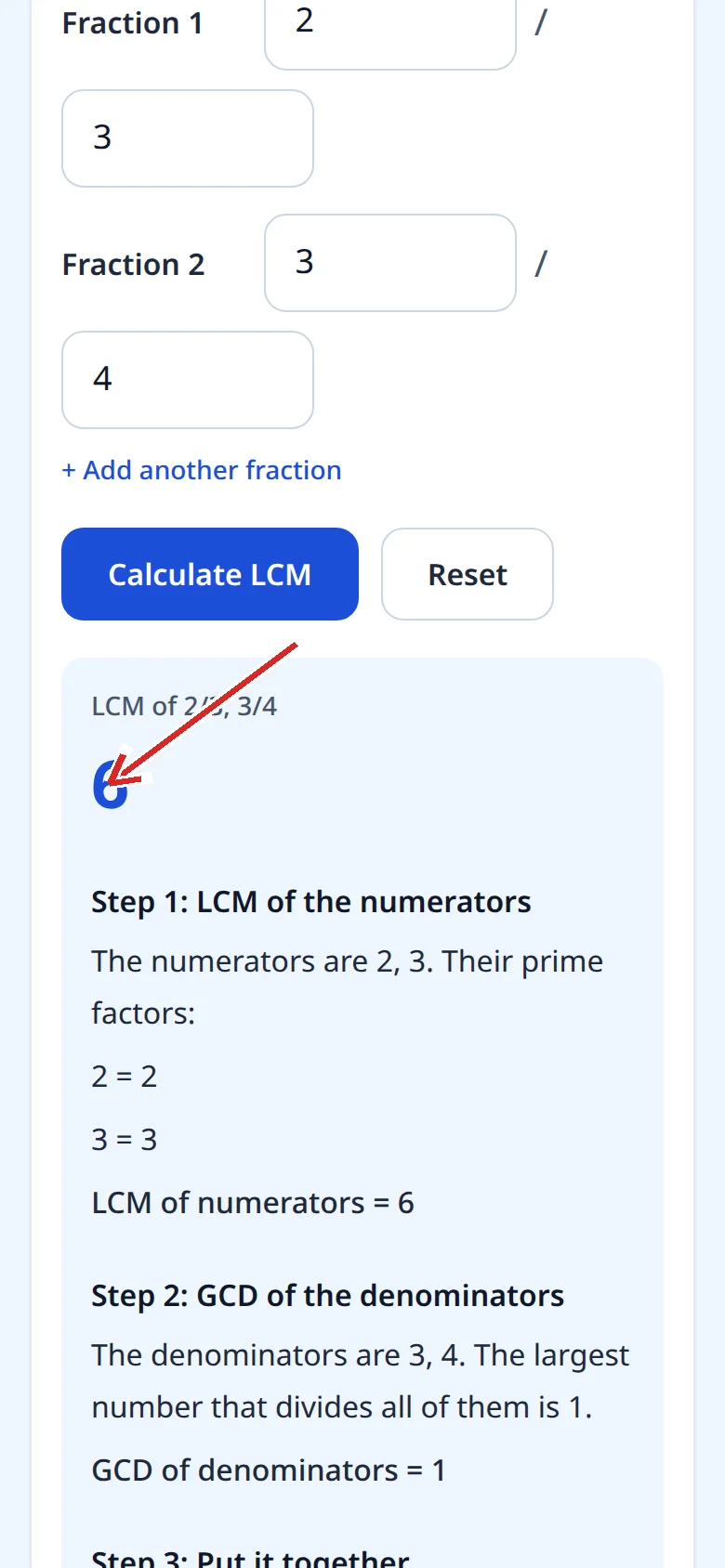
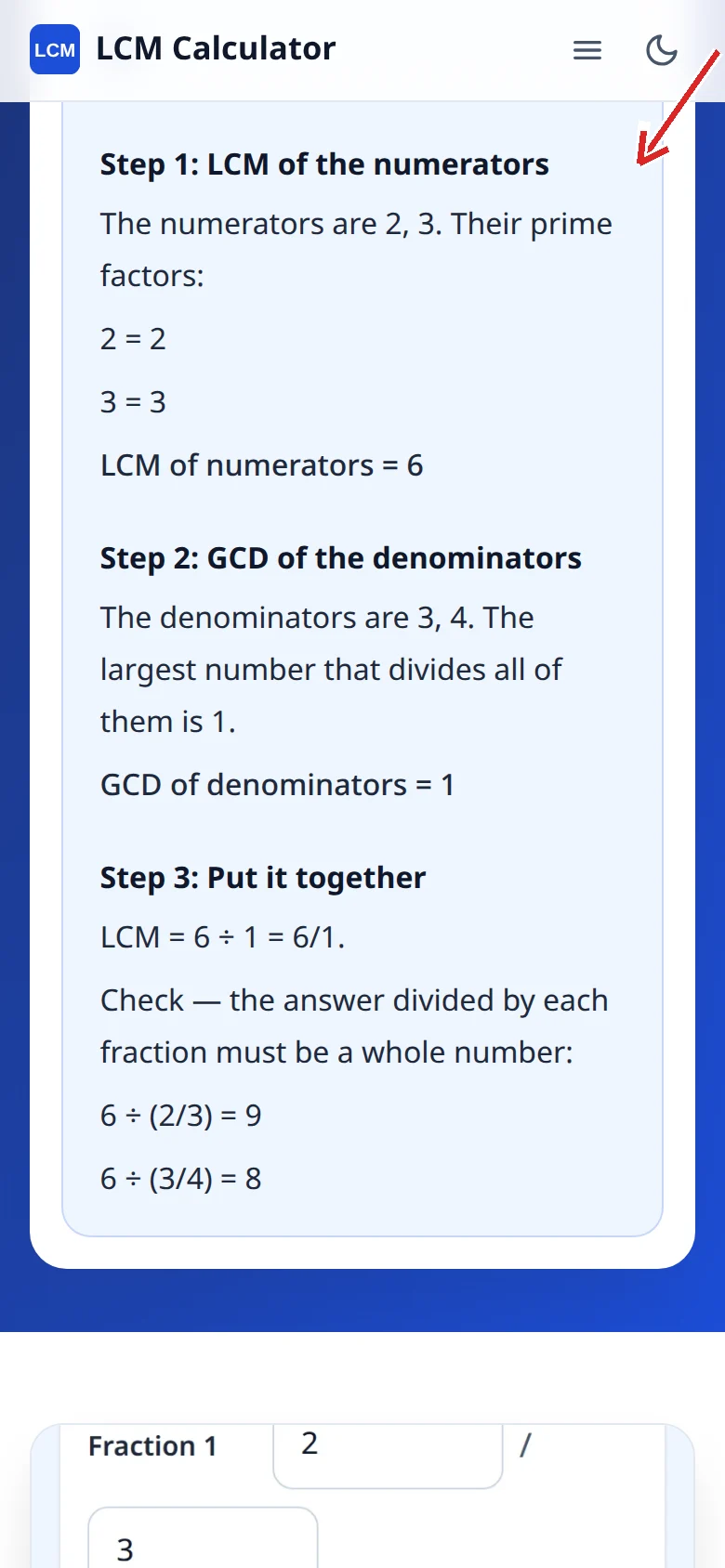
Example 1: LCM of 2/3 and 3/4
LCM(2, 3) = 6
GCD(3, 4) = 1
LCM = 6 ÷ 1 = 6
Check: 6 ÷ (2/3) = 9 and 6 ÷ (3/4) = 8. Both come out whole, and nothing smaller works.
Example 2: LCM of 4/5 and 2/3
LCM(4, 2) = 4
GCD(5, 3) = 1
LCM = 4 ÷ 1 = 4
Check: 4 ÷ (4/5) = 5 and 4 ÷ (2/3) = 6.
Example 3: LCM of 2/9 and 4/15
LCM(2, 4) = 4
GCD(9, 15) = 3
LCM = 4/3
Here the answer stays a fraction. Check: (4/3) ÷ (2/9) = 6 and (4/3) ÷ (4/15) = 5.
Step by step: any set of fractions
- Collect the numerators (the top numbers) and find their LCM.
- Collect the denominators (the bottom numbers) and find their GCD.
- Write the answer as LCM of numerators over GCD of denominators.
- Simplify the fraction if the top and bottom share a factor.
- Check your answer: divide it by each of your fractions. Every division must give a whole number.
Do not confuse this with the LCD
When you add fractions, you need a common denominator, and the least common denominator is the LCM of the denominators alone. That is a different job from the LCM of the fractions themselves. For 2/3 + 3/4, the LCD is 12, so the sum is 8/12 + 9/12 = 17/12. The LCM of the two fractions, as calculated on this page, is 6.
Frequently asked questions
What is the formula for the LCM of fractions?
LCM of fractions = LCM of the numerators ÷ GCD of the denominators. For 2/3 and 3/4, the LCM of 2 and 3 is 6 and the GCD of 3 and 4 is 1, so the answer is 6/1 = 6.
Is the LCM of two fractions always a whole number?
No. The LCM of 2/9 and 4/15 is 4/3, because the LCM of the numerators is 4 and the GCD of the denominators is 3. The answer is a whole number only when the GCD of the denominators works out to 1 after simplifying.
What is the difference between the LCM of fractions and the LCD?
They answer different questions. The LCM of fractions is the smallest number that each fraction divides into evenly. The LCD (least common denominator) is the LCM of the denominators only, and it is what you use to add or subtract fractions. For 2/3 and 3/4, the LCM of the fractions is 6, while the LCD is 12.
Can I find the LCM of three or more fractions?
Yes. Add another fraction with the button and the same rule applies: take the LCM of all the numerators and the GCD of all the denominators. For 1/2, 2/3 and 3/4, the LCM of 1, 2 and 3 is 6 and the GCD of 2, 3 and 4 is 1, so the answer is 6.
What should I do with mixed numbers like 1 1/2?
Convert them to improper fractions first: 1 1/2 becomes 3/2. Then enter the numerator and denominator as usual.