LCM of Multiple Numbers Calculator
Enter up to 10 whole numbers. Use Add another number if you need more boxes.
Finding the LCM of a longer list
For a long list, find the LCM of the first two numbers, then find the LCM of that result and the third number, and so on. With exactly three numbers, the chain is short enough to have its own worked examples. Each step only ever deals with two numbers.
LCM(2, 3, 4, 5, 6)
LCM(2, 3) = 6
LCM(6, 4) = 12
LCM(12, 5) = 60
LCM(60, 6) = 60
A handy fact
The LCM of all the numbers from 1 to 10 is 2,520. That is why 2,520 shows up in puzzles about numbers that divide evenly by everything up to 10.
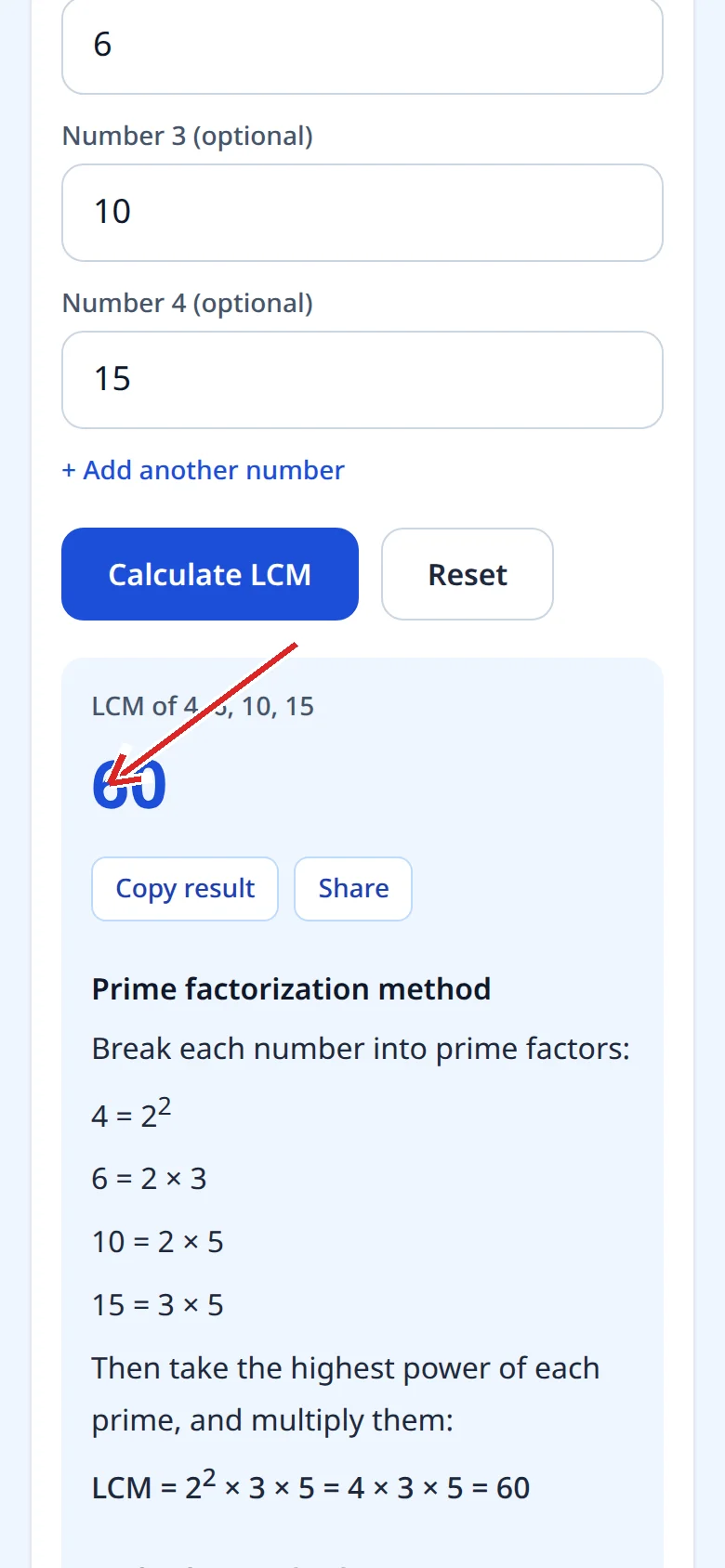
Worked example: LCM of 4, 6, 10 and 15
LCM(4, 6) = 12
LCM(12, 10) = 60
LCM(60, 15) = 60
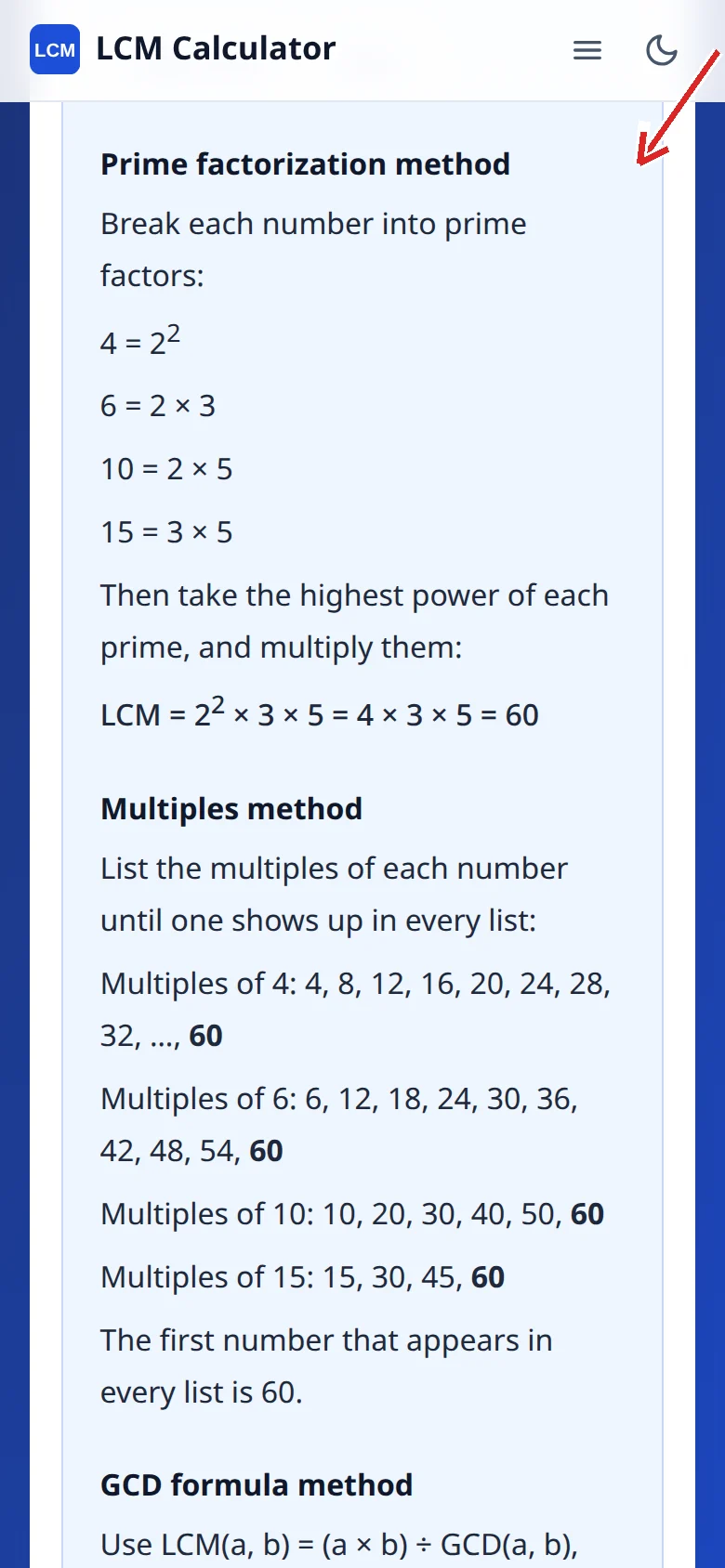
So LCM(4, 6, 10, 15) = 60. Prime factorization agrees: 4 = 2², 6 = 2 × 3, 10 = 2 × 5, 15 = 3 × 5, and the highest powers are 2² × 3 × 5 = 60.
Two ways to handle a long list
The pair chain. Combine the first two numbers, then combine the answer with the next number, and keep going — every step is the ordinary LCM of two numbers all over again. You only ever work with two numbers at a time, which keeps the arithmetic small.
The prime sweep. Factor every number in the list, then take the highest power of each prime that appears anywhere. This is faster when the list is long, and it is the method this calculator uses internally before it shows you the pair-by-pair GCD steps as a check.
Tips that shrink the work
- Drop duplicates. Entering 6 twice is the same as entering it once.
- Drop numbers that divide another entry. In 4, 8 and 12, the 4 adds nothing because 8 is already a multiple of it. The LCM comes from 8 and 12 alone: 24.
- Ignore 1. The number 1 never changes an LCM.
- Watch for a number that is a multiple of everything else. If one entry is a multiple of all the others, it is the answer on its own.
Common lists
| Numbers | LCM | Numbers | LCM |
|---|---|---|---|
| 2, 3, 4, 5 | 60 | 4, 6, 8, 10 | 120 |
| 3, 4, 5, 6 | 60 | 5, 6, 7, 8 | 840 |
| 6, 9, 12, 15 | 180 | 10, 12, 15, 20 | 60 |
When do you need the LCM of many numbers?
Long lists show up when several cycles have to line up at once — production runs, medication schedules, rotating shifts — and in fraction work with several different denominators — though when the fractions themselves need an LCM, a separate formula covers that. They are also a favourite puzzle form: the LCM of the numbers 1 to 10 is 2,520, the smallest number divisible by every number up to 10.
Frequently asked questions
How many numbers can I enter at once?
Up to 20 numbers on this page. Each number can be from 1 up to 1,000,000,000,000, and the calculator uses big-number maths, so the answer stays exact even when it grows to many digits.
Does it matter if I enter the same number twice?
No. A duplicate changes nothing, because the LCM only cares about the highest power of each prime. LCM(6, 6, 10) is the same as LCM(6, 10), which is 30.
Why does the LCM get so big for long lists?
Every new prime that appears in the list has to be included, and primes multiply rather than add. The numbers 1 to 10 already reach 2,520, and adding 11 pushes the LCM to 27,720.
Can I leave some boxes empty?
There are no separate boxes. Type or paste your whole list into the one field, separated by commas or spaces — as few as 2 and as many as 20 numbers.