LCM of Three Numbers Calculator
Enter three whole numbers to find their least common multiple, with the steps shown.
Finding the LCM of three numbers
The easiest way is prime factorization. Break each number into primes, then multiply the highest power of each prime.
6 = 2 × 3
10 = 2 × 5
15 = 3 × 5
LCM = 2 × 3 × 5 = 30
You can also work in pairs. LCM(6, 10) = 30, and then LCM(30, 15) = 30. The order you pick does not change the answer.
Common mistake
Do not multiply all three numbers together and call it done. 6 × 10 × 15 = 900, but the LCM is only 30. Shared factors would be counted more than once.
Worked examples
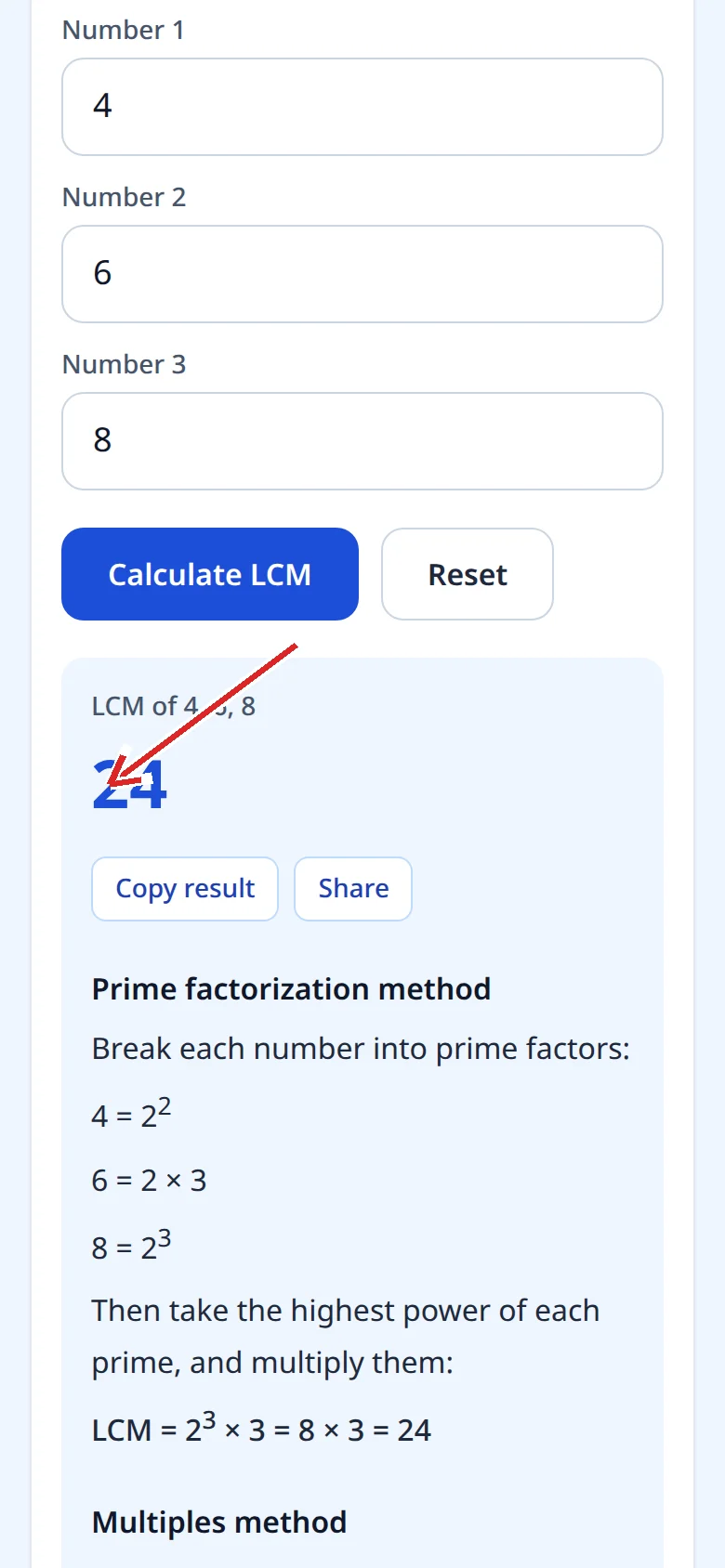
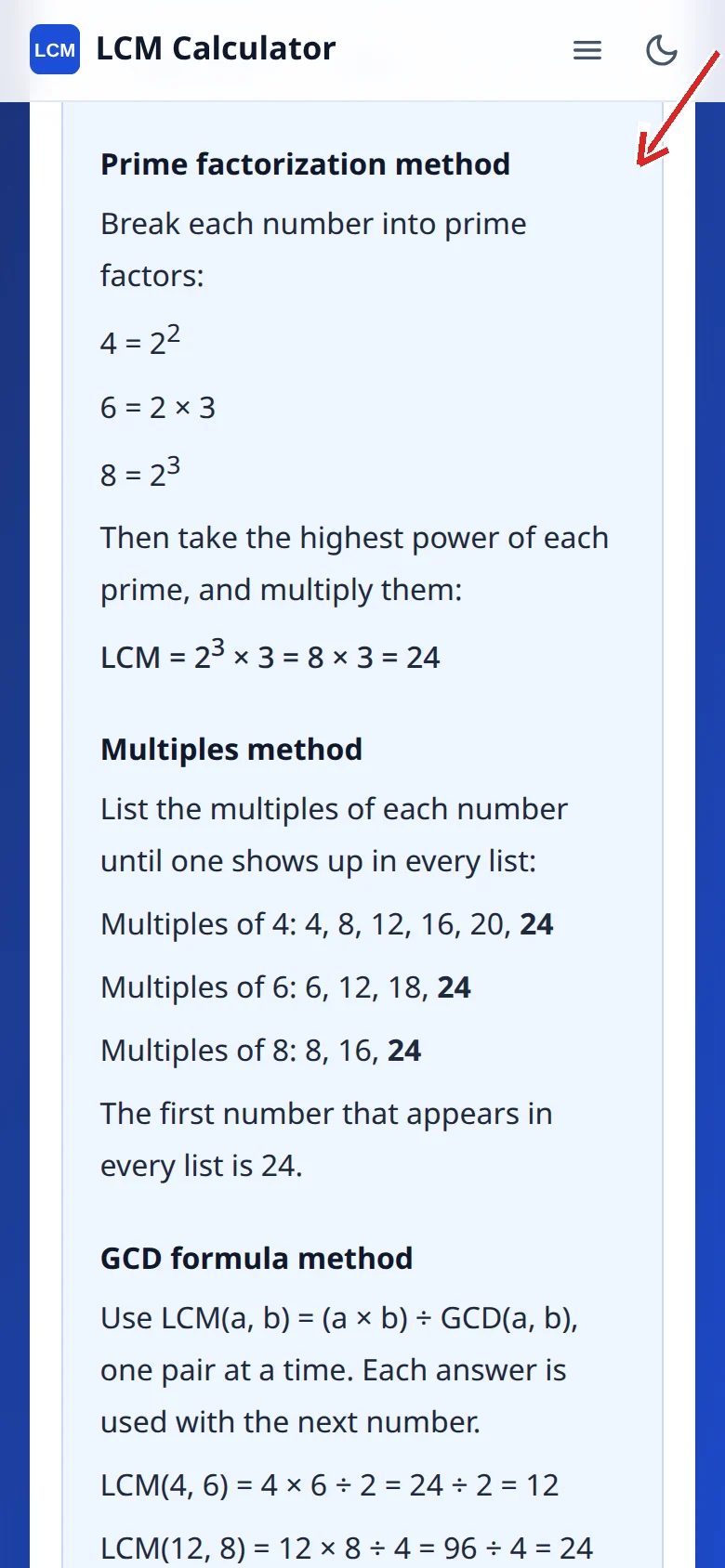
Example 1: LCM of 4, 6 and 8
4 = 2²
6 = 2 × 3
8 = 2³
LCM = 2³ × 3 = 24
In pairs: LCM(4, 6) = 12, then LCM(12, 8) = 24.
Example 2: LCM of 5, 10 and 15
5 = 5
10 = 2 × 5
15 = 3 × 5
LCM = 2 × 3 × 5 = 30
Example 3: LCM of 8, 9 and 12
8 = 2³
9 = 3²
12 = 2² × 3
LCM = 2³ × 3² = 8 × 9 = 72
Step by step: any three numbers
- Break all three numbers into prime factors.
- Scan every prime that appears in any of the three factorizations.
- Keep the highest power of each prime, wherever it appears.
- Multiply the kept powers together — that is the LCM.
Short on time? The pair method is just as reliable: find the LCM of any two numbers, then find the LCM of that answer and the third number. The chain keeps going the same way for four, five or ten numbers.
Common triples
| Numbers | LCM | Numbers | LCM |
|---|---|---|---|
| 2, 3, 4 | 12 | 4, 5, 6 | 60 |
| 3, 4, 5 | 60 | 6, 8, 10 | 120 |
| 5, 6, 7 | 210 | 9, 10, 15 | 90 |
When do you need the LCM of three numbers?
Three cycles lining up is the classic case: three machines that cycle every 4, 6 and 8 minutes are all at the start together again after 24 minutes. The same maths adds three fractions with different denominators, splits a timetable between three repeating events, and solves the three-number LCM questions that appear in middle-school homework and competitive exams. Whenever three different denominators show up in one sum, or three rotas have to coincide on one day, this is the calculation underneath. And if the fractions themselves are what you are combining, they follow their own LCM of fractions rule.
Frequently asked questions
Does the order of the three numbers matter?
No. LCM(6, 10, 15) is 30 in any order, because you are looking for one number that all three divide into. The calculator pairs the numbers up in the order you type them, but every order gives the same result.
What is the LCM of three prime numbers?
The three primes multiplied together, because they share no factors. LCM(2, 3, 5) = 30 and LCM(3, 5, 7) = 105.
What if one number is a multiple of both others?
Then that number is the LCM. In 3, 6 and 12, the 12 is a multiple of both 3 and 6, so LCM(3, 6, 12) = 12. Nothing smaller can be a multiple of 12.
Can I use the two-number formula for three numbers?
Yes, one pair at a time. LCM(a, b, c) = LCM(LCM(a, b), c). First combine two numbers with LCM(a, b) = (a × b) ÷ GCD(a, b), then combine that answer with the third number the same way.